
(Without Surprising Your Board in March)
Most parking lot problems get discovered in April, when the snow finally melts off and your lot looks noticeably worse than anyone remembered it looking in October. That discovery window creates a whole new problem. By April, your 2027 budget is approved and allocated, but the money for a parking lot nobody flagged last fall simply isn’t there. So the project waits a year, and a year of waiting on asphalt is never free.
Back in August we wrote about the window Wisconsin’s weather gives you for sealcoating, crack filling and striping. That article was about the paving calendar set by the weather. This one is about the calendar your organization sets, and unfortunately, the two schedules almost never line up.

Your Budget Calendar & Your Pavement Calendar Are Out of Sync

What happens? You approve the budget when your lot looks its best, and you inspect the lot when your budget is already spent. Luckily, the fix isn’t complicated! It’s a site walk-through and a written number now, while the lot is still visible and the budget is still open.
A written scope in the fall is not a commitment to spend. It’s a line item you can fund, phase, or defer, with real information in front of you instead of a guess.

This Winter Deserves a Closer Look Than Most
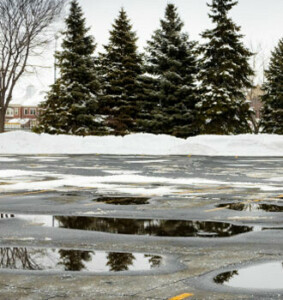 There’s a specific reason to get ahead of this particular budget cycle.
NOAA’s Climate Prediction Center has El Niño at advisory status heading into fall 2026, with a greater than 90 percent chance the event reaches “very strong” through the winter. Forecasters currently put roughly a 75 percent chance on this being the strongest El Niño in the record going back to 1950, stronger than 1982–83, stronger than 1997–98.
For southeastern Wisconsin, the historical pattern is reasonably consistent: milder winters, and usually less snow. Upper Midwest winter temperatures are projected to run roughly 2 to 4 degrees above normal. And the National Weather Service in Milwaukee notes that of the last seven strong El Niños, six brought near-to-below average snowfall to southern Wisconsin.
A mild winter with less snow sounds like good news for your parking lot, but for asphalt, it usually isn’t.
Why a Warm Winter is Harder on Asphalt Than a Cold One
The thing that breaks pavement isn’t the cold, it’s the crossing. Water works its way into a crack, that crack freezes and expands about nine percent, prying the crack a little wider. Then it thaws, and more water seeps down into the space it just created. Then it freezes again. Every trip across 32 degrees is one of those cycles, and the damage accumulates cycle by cycle.

A lot that freezes solid in December and stays frozen through February goes through relatively few of them. The water in the pavement is locked up and isn’t going anywhere.

A lot that sits in the 20s overnight and climbs into the upper 30s by mid-afternoon crosses that line twice a day, every day, for months.
You read that right! Less snow makes the freeze and thaw cycle worse rather than better. A blanket of snow insulates pavement and moderates its temperature swings, while bare pavement takes the full swing of the freeze and thaw, absorbing sun during the day, radiating heat away at night. And a winter that delivers rain and ice where it used to deliver snow means more liquid water available to get into your cracks, plus more salt applications on the days things glaze over.
The winters that do the most damage to asphalt aren’t the brutal ones. They’re the ones that can’t make up their mind.
A Forecast Is Not a Guarantee
One honest qualifier, because you’ll want it before you repeat any of this to a board: seasonal outlooks are probabilities, not promises. El Niño loads the dice toward a mild, low-snow winter in southern Wisconsin. It doesn’t guarantee one, and the NWS record includes at least one strong El Niño winter that ran well above average for snowfall. But budgets aren’t built on certainty, they’re built on likelihood, and this year the likelihood points toward a freeze-thaw winter rather than a deep-freeze one.

Three Numbers Worth Putting in Front of Your Board
9%
How much water expands when it freezes. That expansion is the entire mechanism behind pavement failure in a northern climate. Every open crack on your lot is a place where it gets to happen.
2 to 4 Degrees
How far above normal upper Midwest winter temperatures are projected to run this season. Not enough to notice on any given day, but more than enough to push a lot of nights across the freezing line and back again.
6 of 7
Strong El Niño winters out of the last seven that brought near-to-below-average snowfall to Milwaukee. Less snow on your lot means less insulation, not less wear.
What Actually Belongs in the 2027 Budget
Pavement spending falls into two buckets, and the single most useful thing you can do for your own approval odds is keep them separate.
01 | Operating budget: pavement maintenance
Crack filling, sealcoating, striping, and ADA markings.

These are the things you do on a schedule regardless of whether anything looks wrong, and that’s exactly what makes them budgetable. Crack filling is annual for most lots. Sealcoating runs on a three-to-five-year cycle depending on traffic and sun exposure. Striping gets refreshed as it fades, usually alongside a sealcoat since the two have to happen in that order.
Because the interval is predictable, the cost is too. A lot that got sealed in 2025 isn’t due again until 2028 or 2029, which means you can plan several years out and know roughly which years carry the bigger number. If your property has multiple lots or a large campus, this is also where phasing helps: seal a third of the square footage each year and the line stays flat instead of spiking every fourth budget.
The trap to avoid is treating maintenance as a project you fund when something looks bad. Once it’s reactive, it’s no longer maintenance, it’s repair, and it’s priced accordingly. Write it in as a recurring annual line with a note on which services are due in which year.
02 | Capital budget: pavement repair and replacement
Mill and overlay, full-depth patching, base repair, drainage correction, and reconstruction.

These repair actions share one thing: they’re all fixing damage that already happened, usually below the surface. Mill and overlay grinds off the top layer and replaces it, which is needed when the surface is spent but the base underneath is still sound. Full-depth patching and base repair go all the way down, and they’re what you’re looking at once water has been getting into the subgrade long enough to soften it. Drainage correction often belongs with either one, because a lot that holds water will destroy a new surface the same way it destroyed the old one.
Capital work is irregular – it doesn’t happen on a clean interval, the number is large enough to need its own justification, and in most organizations, it competes directly against other capital requests rather than sitting quietly in an operating line.
That’s the practical reason to separate the two budget types: capital approval usually requires evidence. A photo of the failure, a condition finding explaining what caused it, and a defensible reason why it can’t wait another cycle. If you know a capital item is coming in 2028 or 2029, name it now as a planned future expense even if you’re not funding it yet. Boards forgive a large number they saw coming, but they are less likely to forgive a surprise.

The Budget Three Lines Most Lots Should Carry
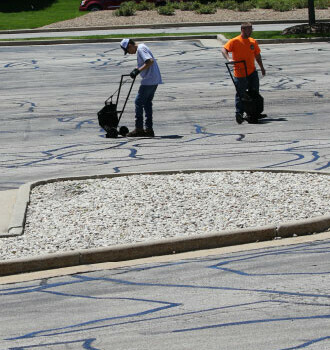
01 | A recurring maintenance line: crack filling annually, sealcoating on a three-to-five-year cycle, and striping as it fades. This is the cheapest money you will ever spend on pavement, and it is the only category that reliably prevents the expensive kind.
02 | A repair line: for problems you already know about, like failing corners, the settled catch basin, or the section that’s been patched three times. If you’re not sure which category a problem falls into, that’s exactly what a site walk is for.
03 | A contingency or reserve line: because the spring thaw is going to reveal something. Boards that carry 10 to 15 percent for the unknown don’t have to reopen an approved budget when it does.
 AVOID: A single “parking lot” number with no scope behind it: this is the line most likely to get cut, for a simple reason: nobody in the room is able to defend it.

What a Real Written Asphalt Project Scope Should Contain
If you’re taking a number to a board, the number needs documentation to justify the ask. Strengthen your position by asking your contractor for:


If a contractor won’t put the reasoning in writing, what you have is a price, not a scope. Prices are difficult to defend in a board meeting, but scopes aren’t. Your asphalt contractor should work for you, not against you, to lock in your budget.

The Four Questions Your Board Will Ask

Because the cost curve isn’t flat. Crack filling is a surface treatment measured in cents per linear foot. Once water reaches the base, you’re into structural repair, which is a different order of magnitude entirely. The whole argument for acting early is that the gap between those two numbers is enormous and it only moves in one direction.
02 | “What happens if we defer?”
A fair question that deserves a specific answer rather than a scare. A good scope will tell you which items can wait a season with little consequence and which ones will cost meaningfully more next year.
03 | “Why this number and not the cheaper bid?”
Usually because the two bids aren’t for the same work. Be sure to compare scope lines, not totals. If one quote doesn’t mention filling cracks before sealing over them, it isn’t cheaper, they’re just offering you less or lower quality work.
04 | “Is this operating or capital?”
Have the answer ready before you’re asked. This question stalls more pavement approvals than the price does. We’ve written more on building a defensible paving budget here.

A Few Things Worth Doing Before the Snow Flies
Even if the money is already committed for this year, a handful of things get easier when they happen in the fall rather than the spring:
crack filling has the longest seasonal window of any maintenance service and it is the single highest-return thing you can do before a freeze-thaw winter. Keeping water out of the cracks in your asphalt is what stops a surface problem from becoming a base problem.
a dated set of photos from October gives you a real before-and-after in April, and it makes the case for next year’s line item far more persuasive than a description.
Faded ADA markings are a liability issue, not a cosmetic one, and they don’t improve over a winter.
repeated piling in the same spot concentrates meltwater and salt in one area, and that area is usually the first to fail.

Work with Johnson and Sons Paving We’ll Come Present to Your Board
One of the more common reasons a pavement project stalls isn’t cost. It’s that the person carrying it into the meeting is being asked to defend technical recommendations they didn’t write.
If it’s useful, we’ll walk your lot, put a written scope in your hands, and then come present it to your board, association or leadership team ourselves. Our expert project managers will explain what we found, what we’d recommend, what can wait, and answer the questions directly. There’s no charge for it and no obligation attached.
Let’s Get Your Number Before Your Budget Closes

Johnson and Sons Paving serves commercial properties, MDUs, condo associations, schools, healthcare campuses, and facility teams across Ozaukee, Washington, and Waukesha Counties and the North Shore. We own our own asphalt plant, run our own fleet, and self-perform the work, so you have one point of accountability from the site walk to the final stripe, and one person to ask when your board has a question.
We’ll assess your lot, tell you honestly what belongs in 2027 and what can wait, and put a written scope in your hands that you can take straight to ownership, a board, or a budget meeting.
Call (262) 251-5585 or Request a Quote