What a Sealcoat, Crack Fill & Striping Schedule Actually Saves You
A well-built commercial parking lot should last 20 to 30 years. Whether yours actually does has surprisingly little to do with the day it was paved, and almost everything to do with what happens in the years after. The lots that hit that 30-year mark aren’t lucky, they’re on a parking lot maintenance program.
Every summer, we walk properties across southern Wisconsin where the pavement is 10 years old but looks 20, right next to lots the same age that look nearly new. The difference is no mystery at all. One owner treated their parking lot maintenance as a scheduled program with a predictable budget line. The other waited for problems to announce themselves, and by the time asphalt announces a problem, it’s already an expensive one.
Here’s how a real maintenance program works, what it costs relative to the alternative, and why July and August are exactly the right months to put one in place.
Why a Program Beats a Reaction Every Time
Asphalt doesn’t fail all at once. It fails in a predictable sequence: first, the surface oxidizes and turns gray, then hairline cracks open and water gets in, and then Wisconsin’s freeze-thaw cycles widen the damage, and eventually the base underneath is compromised. Each stage is dramatically more expensive to fix than the one before it. Knowing whether your lot needs a repair, a reseal, or a replacement is the difference between a line item and a capital project.
A maintenance program interrupts that sequence early, on your schedule, at the cheapest possible stage. And beyond the pavement itself, it does two things decision-makers care about:
It makes your budget predictable: Instead of a surprise six-figure repave request, you have known, modest annual costs your board, ownership group, or finance team can plan around.
It documents due diligence:
Uneven surfaces, potholes, and faded markings are among the most common sources of slip-and-fall claims on commercial properties. A written, dated maintenance record is your first line of defense if a claim is ever filed.
Here are three numbers worth keeping in front of your budget and decision makers:
5 – 10x
the cost difference between repairing a structural pavement failure and preventing it with routine maintenance.
20 – 30 years
what a properly installed and properly maintained commercial lot should deliver. Most underperforming lots never get close.
3 – 5 years
how often a commercial lot should be sealcoated to keep the surface protected. If you can’t remember your last sealcoat, you’re due.
Our Four-Part Parking Lot Maintenance Program, Include What Gets Done & When
01 | Crack Filling
Do this every year!
This is the single highest-ROI task in pavement maintenance, no exceptions! Cracks are how water reaches your base layer, and water plus a Wisconsin winter is how small problems become structural ones. Filling cracks annually, ideally in warm months when the filler penetrates and bonds properly, costs a few hundred to a few thousand dollars depending on lot size. Skipping it is how a few-hundred-dollar problem becomes a few-thousand-dollar pothole by spring.
02 | Sealcoating
Do this every 3 to 5 years!
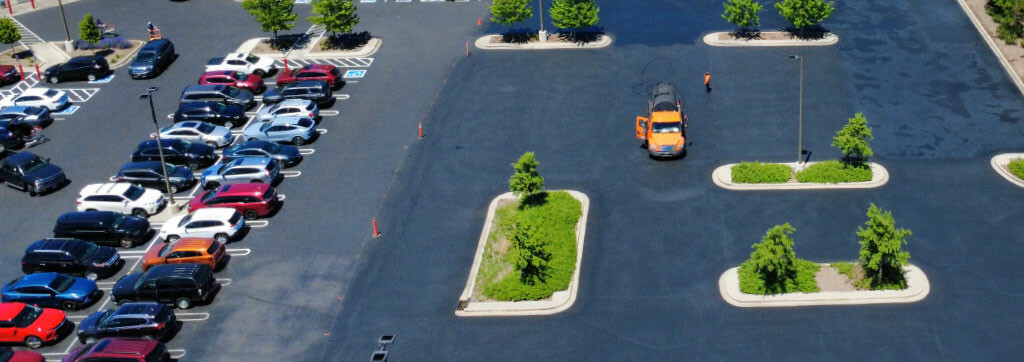
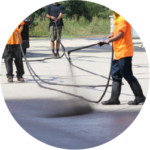
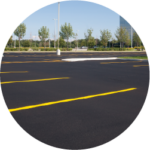
Sealcoating is sunscreen for your asphalt. It shields the surface from UV oxidation, water infiltration, and chemical damage from oil, fuel, and winter salt, and it restores that deep black, freshly-paved look that tenants and customers notice. The short version: it adds years to your pavement’s life for a small fraction of what resurfacing costs, and warm, dry summer weather is when it cures best. Here’s everything you need to know about sealcoating in under five minutes.
03 | Striping & Markings
Do this every 3 to 5 years or with every sealcoat!
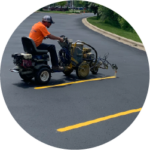
Striping wears faster than owners expect, thanks to traffic, plowing, and sun. Faded lines don’t just look neglected; they create real liability around fire lanes, crosswalks, and accessible spaces. Every restripe is also the natural moment to confirm your lot is ADA compliant and includes the correct number of accessible spaces, proper access aisles, compliant signage, and legal slopes. If your lot has been restriped the same way since it was built, there’s a good chance the layout predates current requirements.
04 | The Annual Walk-Through
Do this every spring and after every project!
A program only works if someone is paying attention to your pavement. Once a year, walk the lot, or have us do it with you, and note new cracks, standing water after rain, soft or crumbling edges, plow damage, and fading markings. Standing water deserves special attention: drainage problems are the number one driver of premature pavement failure, and they never fix themselves. Our property manager’s guide to getting the most out of your parking lot investment includes a season-by-season checklist you can hand to your maintenance team today.
What a Program Costs vs. What Waiting Costs
Every property is different, and any number offered without a site walk is a guess. But for planning purposes, a full maintenance year, including crack filling plus a sealcoat-and-restripe cycle year, typically lands in the low four figures to low five figures for a mid-size commercial lot. Spread across the 3-to-5-year cycle, that’s a modest, predictable annual line item.
But now, let’s compare the alternative. Deferred maintenance doesn’t pause the deterioration, but it does compound it. The crack that costs a few hundred dollars to fill this July becomes a pothole network by next spring, and a base failure the year after that. At that point you’re not maintaining, you’re repaving. That’s sometimes the right call, but it should be a decision you plan for on your timeline, not one a failed lot makes for you. Here’s what a repaving project actually involves.
Why Mid-Summer Is the Right Time to Start Your Maintenance Program
If you’re reading this in July, your timing is genuinely good! June and July are Wisconsin’s sweet spot for asphalt work, and that goes double for maintenance. Warm temperatures keep crack filler workable, so it penetrates and bonds properly. Sealcoat cures faster and more consistently in summer heat. Striping paint dries quickly and cleanly, often letting us complete markings work in a single day with minimal disruption.
Sealcoating and striping need warm, dry conditions, and in Wisconsin that season closes earlier than most people think. A maintenance program that starts now gets the full benefit of ideal conditions and heads into winter protected. One that waits until October is racing the frost.
A credible paving partner, like Johnson and Sons Paving, builds the schedule around how your property actually operates: early morning starts before customer traffic, section-by-section phasing so the lot never fully closes, and clear communication to tenants before anyone loses a parking spot. If a contractor’s maintenance proposal doesn’t ask how your property is used, keep looking.
Let’s Put Your Lot on a Program
At Johnson and Sons Paving, we build maintenance programs for commercial properties, retail centers, MDUs, condo associations, and office parks across Ozaukee, Washington, and Waukesha Counties and the North Shore. Because we own our own asphalt plant, produce our own materials, and run our own crews and fleet, there are no subcontractor delays and one point of accountability, from the very first crack we fill to the very last stripe we paint.
Our team will walk your property with you and map out exactly what a program looks like for your lot:
Current surface and base condition, and which maintenance tier your lot actually needs
A crack fill, sealcoat, and striping schedule matched to your pavement’s age and condition
ADA compliance status and what (if anything) needs updating at your next restripe
A multi-year cost picture your board or ownership group can budget around with no surprises
With Johnson and Sons Paving, there’s no pressure and no upselling to work you don’t need. Just an honest read on where your lot stands and a plan that keeps the big bills off your desk.