Take Advantage of Wisconsin’s Window for Sealcoating, Crack Filling, & Striping
Sealcoating is not paving, and the difference between the two will help define your deadline for booking this season. When we repave a lot, the asphalt arrives at roughly 300 degrees. But the clock we’re racing against to get a lot or driveway paved is a clock we can influence. Our own plant controls mix temperature, our mixers hold heat in transit, and an experienced crew adjusts in real time.
When it comes to sealcoating, we don’t have as much control over the conditions. Asphalt sealer is a cool, water-based emulsion, and from the moment it goes down, the weather does all the work. That means the conditions below aren’t just a preference, they’re a rule.
The Ideal Conditions for a Successful Sealcoat
Minimum application temperature (air and surface): 50°F and rising
Minimum overnight temperature for the 24 hours following application: above 50°F
Cure before traffic returns: 24–48 hours
Rain-free window required after application: 24 hours minimum
Ideal application conditions: 65–75°F, low humidity, direct sun
But It’s 76 Degrees Out! Why Can’t You Sealcoat My Lot?
Every September we have some version of the same phone call:
A property manager calls in the third week of the month. It’s 76 degrees outside, the sun is out, there hasn’t been rain in nine days, and the forecast looks beautiful. They want to know why we’re telling them their parking lot can’t be sealcoated until spring.
It’s a fair question, and it comes up all the time. Most people assume paving and sealcoating run on the same calendar. They don’t, but it’s less about the weather and more about what the sealcoating process requires.
Back in June, we wrote about why June and July are the sweet spot for asphalt paving. That post was about laying hot asphalt, which is the process where our own plant, our own fleet, and an experienced crew let us stretch the season on both ends. This article is the other half of that story, and it works in almost exactly the opposite way.
Sealcoating Isn’t Paving & It Has a Harder Deadline
Hot asphalt shows up to our project sites at roughly 300 degrees, and everything we do is a race against it cooling. But that’s a race we can win. We control mix temperature at our own plant, our mixers hold heat in transit, and our crews adjust roller patterns on the fly. It’s why we can pave on days a less-equipped contractor would have to postpone.
Sealcoating doesn’t work that way.
Asphalt sealer isn’t applied hot. It’s actually a water-based emulsion made up of asphalt or solids suspended in water, held apart by surfactants so the whole thing stays liquid in the tank. Nothing about it is heated on site; it goes onto your lot cool, and from that moment forward, the weather does all the work. There is no piece of equipment on earth that makes a cool, damp night into a warm, dry one.
For repaving, hiring a contractor with their own plant and crews expands your window. For sealcoating, it doesn’t. Physics sets the deadline, and every paving company has to work within it.
What’s Actually Happening While Sealer “Dries”
The word “drying” isn’t quite right, because two separate things have to happen for seal coat to cure and drying is only one step.
STAGE ONE: the water leaves. Evaporation lifts the water out of the emulsion. For this to happen properly, we need warmth, air movement, low humidity, and sun. It’s the stage everybody pictures, and it’s the fast one.
STAGE TWO: the particles fuse together. As the water disappears, the suspended asphalt particles are pressed together and have to coalesce (this is a fancy term for allowing the particles to flow into each other and knit into one continuous, unbroken film across your pavement). This is the stage that actually determines whether you got a sealcoat or just a coat of dark-colored disappointment.
But coalescence does have a temperature floor. If the weather dips below roughly 50 degrees, those particles stay stiff and never fully merge. The sealcoat you’re left with looks fine on the first day and is all but gone by December. Uncured sealcoat powders, wears through in traffic lanes, and doesn’t do the one job you paid for, which is keeping water and salt out of your asphalt through a Wisconsin winter.
So when we say 50 degrees, we’re not being picky. Any temperatures below that, the sealcoat doesn’t cure slowly, it just doesn’t cure at all.
And it’s not just about the temperature when we show up. It has to be 50 and climbing when we start, and it has to stay above 50 for the next 24 hours or so while the coat finishes curing. That overnight part is where September gets people.
Three Numbers You Need to Know When Planning Your Sealcoat
50°F and Rising
It needs to be at least 50°F when we start application and has to stay above 50°F for the full cure of the seal coat. The most common cause of premature sealcoat failure in Wisconsin isn’t bad materials. It’s good material applied on a warm afternoon followed by a cold night.
24 hours
This is the minimum rain-free, dew-free window a fresh sealcoat needs to cure successfully. One overnight surprise inside that window is enough to undo the entire application.
1 hour and 26 minutes
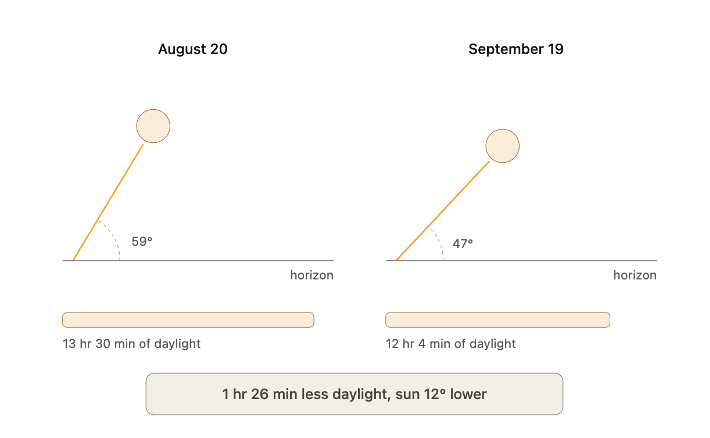
The amount of daylight Milwaukee loses between August 20 and September 19. Warmer temperatures don’t make up for loss of sunlight. Sealcoat needs both to be successful.
“But September Has Been Beautiful Lately”
You’re right, it definitely has been!
Recent Septembers in Wisconsin have skewed warm and dry. According to the Wisconsin State Climatology Office, the warmest September on record came in 2015, and September 2024 was exceptionally warm as well, with a statewide average high of 77 degrees. The last five Septembers have all run drier than average, and 2024 ranked as the eighth driest since records began in 1895. Thunderstorm activity also typically tapers off through the month as the state dries out.
So if you’re looking at all that and thinking September sounds like a great month to seal a parking lot, we get it. Those numbers do look good, but they leave something out.
Wisconsin’s average September temperature is just under 60 degrees.
Now put that next to the 77-degree average high from 2024. If the highs are in the upper 70s but the month averages around 60, the nights have to be pulling a lot of weight. A beautiful 76-degree afternoon in Milwaukee will easily turn into a 50-degree night.
The afternoon is what you notice, but the night is what your sealcoat has to get through.
Dry, Clear Nights Are Exactly How You Get Dew & Dew is Bad for Sealer
Everybody knows rain is bad for fresh sealer, but almost nobody thinks about dew, and in September, dew is the bigger problem.
On a clear, calm night there are no clouds to hold heat in, so the ground gives up its warmth to the sky and cools off fast. Once the pavement gets cold enough, moisture in the air condenses right onto it, usually heaviest in the hours before sunrise.
Read that back and you’ll notice something: clear, calm, no clouds. That’s a beautiful night, but the same high pressure that gives September its long dry stretches is what produces the heaviest dew of the season. The forecast that looks best is the one working against you overnight.
And there’s no warning for dew – we don’t get a “dew alert” sent to our phones. We can seal a lot on a perfect Thursday afternoon and come back Friday morning to tracking, blotching, and uneven color.
Daylight and Sun Angle Don’t Negotiate
This next one has nothing to do with the weather, and no warm spells can fix it.
On August 20, Milwaukee gets about 13 hours and 30 minutes of daylight, and the sun sits around 59 degrees above the horizon at midday. By September 19, that’s down to about 12 hours and 4 minutes, with the midday sun topping out near 47 degrees.
That’s a full hour and a half of curing daylight completely gone. The lower sun angle costs you too. A low sun spreads its energy over more ground, so your asphalt just doesn’t warm up the way it did in August. Two afternoons can both read 75 degrees and feel completely different underfoot.
So the workable part of each day is shrinking from both ends. Morning dew takes longer to burn off, and the pavement starts cooling earlier in the evening. No matter how warm the forecast looks, there’s less usable time in the day than there was a month ago.
So How Many Days Do You Actually Have Left?
Look at a calendar in late August and it looks like you’ve got weeks to work with, but then you’ll have to start crossing days off.
Rain days are the first you’ll need to cross off, along with the day, because pavement has to be completely dry before we can put anything down. One afternoon thunderstorm usually costs two days, not just one. Next, you’ll have to cross off the mornings when heavy dew pushes our start time so late the coat can’t finish curing before dark. Now, cross off anything that doesn’t reach 50 degrees, plus the days that get there in the afternoon but won’t hold it overnight. And if your lot has to stay open for business, cross off whatever your phasing plan can’t work around.
Whatever’s left is always fewer days than people expect in mid-August.
That’s why we tell people to call now. It’s not because of some deadline we made up. The truth is, the season doesn’t end on a specific date each year, it ends when you run out of days that work.
What Still Works Late & What Doesn’t
These three services don’t close at the same time, so it’s worth knowing which is which.
Crack filling has the longest window.
Hot-pour crack filler goes down at high heat and bonds right to the crack walls, so it handles cool weather far better than sealer does. Cooler weather actually helps a little: asphalt shrinks as it cools, so the cracks are at their widest and the filler gets deeper. If you’re reading this late and can only do one thing before winter, do this. Keeping water out of your cracks is what stops a surface problem from turning into a base problem.
Re-Striping and Fresh ADA Markings Are Still Possible.
Traffic paint has its own temperature minimum and needs to dry before dew, but it needs less time than a sealcoat, so we can usually stripe later than we can seal. This is worth doing on its own if you’re out of time for anything else. Remember, faded accessible-space markings are a slip-and-fall risk and an ADA problem. One catch: if you’re doing both, sealing has to come first, so the sealcoat deadline sets the schedule for the pair.
Waiting until spring.
A lot that goes into winter unsealed with open cracks doesn’t just sit there. Water fills the cracks, freezes, and widens them. Salt eats at unprotected asphalt. What costs a few hundred dollars to fix in September routinely costs thousands by April, and that gap is the whole case for staying ahead of it.
Questions You Should Ask Before You Book Your Sealcoat
Will they walk the lot before quoting, or price it off a satellite image?Crack severity and drainage problems don’t show up from above.
What’s their stated overnight temperature threshold, and will they postpone if the forecast turns? A contractor who’ll seal on any day you ask is telling you something about their standards.
Are cracks being filled before sealing?Sealer is not a crack filler. Applying it over open cracks buries the problem without solving it.
How is the lot being phased so you don’t lose all your parking at once? Most maintenance work can be sectioned off a piece at a time. Any crew that’s worked around a hospital or a school knows how.
What happens if we miss the window? An honest contractor will tell you what’s still worth doing this fall and what’s genuinely better in spring, rather than selling you a sealcoat that won’t cure.
Let’s Walk Your Lot While the Window Is Still Open
Johnson & Sons Paving serves commercial properties, MDUs, condo associations, schools, healthcare campuses, and facility teams across Ozaukee, Washington, and Waukesha Counties and the North Shore. We own our own asphalt plant, run our own fleet, and do the work on our own so you have one point of accountability from the site walk to the final stripe.
We’ll assess your lot, tell you honestly which services still fit this season and which are better held for spring, and put a written scope in your hands you can take to ownership or a board.


 For repaving, hiring a contractor with their own plant and crews expands your window. For sealcoating, it doesn’t. Physics sets the deadline, and every paving company has to work within it.






 Waiting until spring.


